Carousel, Walking Beam or Planar mover system? A strategic architecture decision in life science filling.
In biomedical and life science automation, transport architecture is often chosen by inertia, we replicate the last project, use what the team already knows, or accept the OEM's default proposal.
Yet this single decision directly shapes machine footprint, achievable throughput, cleaning strategy, laminar airflow integration, and, critically, the scope of validation activities required before you can run a single production batch.
Over the past months we've worked in parallel on vial filling lines, pre-filled syringe systems, and various plastic container formats. Every time, the same question came back.
Carousel: hard to beat when the process is well-defined
For monoblock systems with 2–6 stations - filling, stoppering, capping etc - the carousel remains the most efficient architecture available.
The circular geometry minimises the critical zone exposed under laminar flow. Surfaces are smooth, with no belt systems or complex mechanical interfaces that complicate cleaning qualification. Station synchronisation is native and mechanically deterministic: every unit follows exactly the same physical path, at the same speed, every cycle.
That last point matters more than it might seem. Deterministic behaviour is the foundation of a clean IQ/OQ/PQ approach. Regulatory inspectors have decades of experience auditing carousel-based systems. The reference documentation is consolidated, the precedents are many.
CapEx is the lowest of the three architectures.
Real limitation: the carousel scales poorly with the number of stations. Adding operations means increasing the rotor diameter and that relationship is not linear. Beyond a certain number of stations, the compactness advantage disappears, mechanical balancing becomes more complex, and a linear layout starts to make more engineering sense. Accessibility to individual stations during setup and maintenance can also be more constrained compared to a linear architecture, given the reduced working space around a central rotating axis.
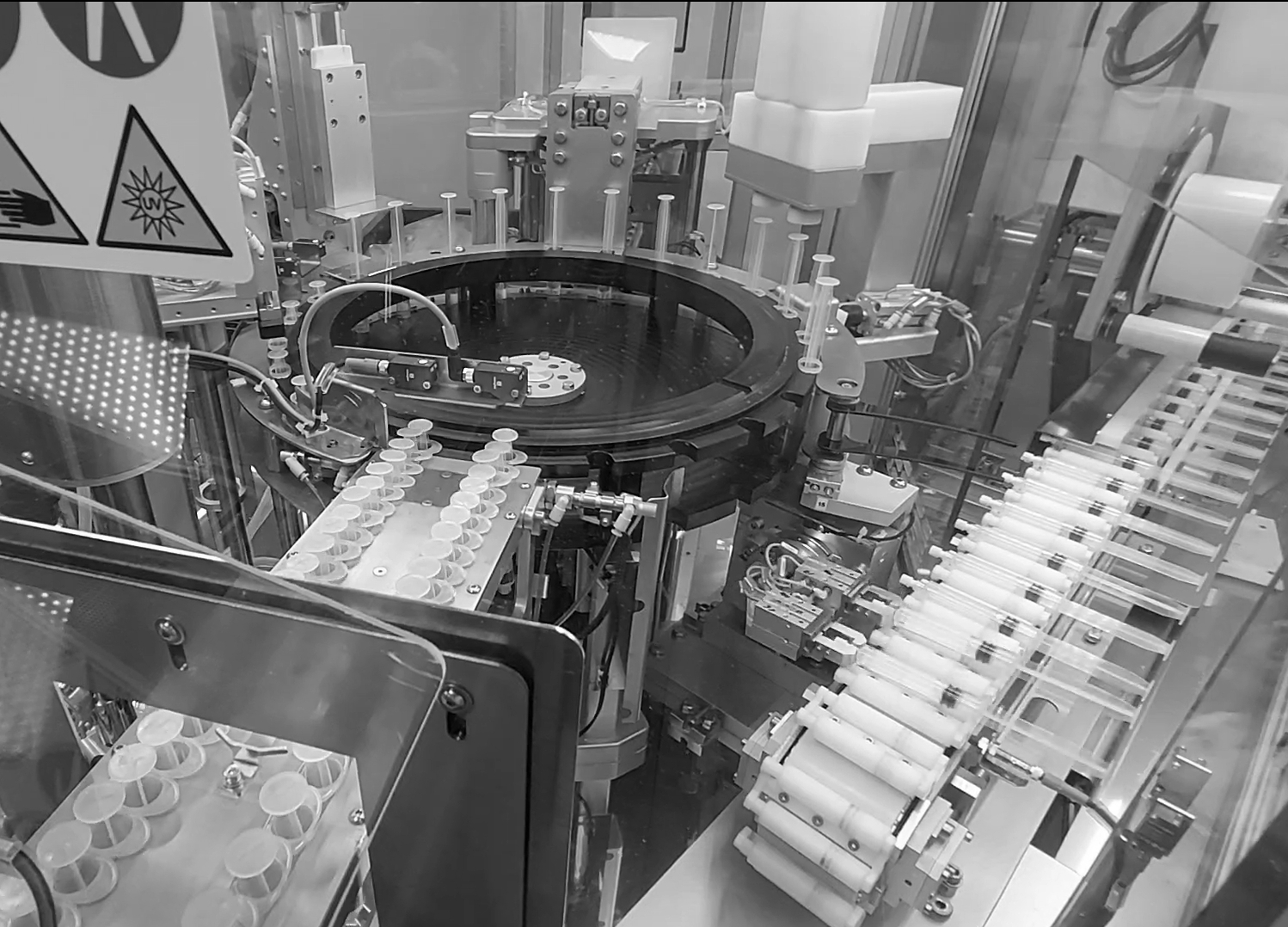
Walking Beam: linear precision, excellent cleanability: watch the footprint
The walking beam earns its place when a linear layout is architecturally required, either because of upstream/downstream integration constraints, room layout, or because the number of sequential operations makes a rotary geometry impractical. It delivers clean, controlled product transfer with no continuous contact surfaces and high positional accuracy at each station, while keeping the process flow naturally readable and accessible along its entire length.
The validation approach is mature. The mechanics are predictable and well-understood by most QA teams.
Real limitation: the line grows linearly with the number of stations. Beyond 6–7 operations, the footprint becomes critical: in a cleanroom environment, every square metre has a significant cost attached.
Planar mover systems: the paradigm shifts, but physical constraints remain
Planar mover systems, such as Beckhoff XPlanar, introduce a genuinely different model. Each mover is an autonomous unit, magnetically levitated, independently tracked and dynamically routable. Format changeover becomes predominantly software-driven. Native per-unit traceability comes out of the box.
The advantage is real in high-variability scenarios: multi-SKU production, R&D pilot lines, facilities where format mix changes multiple times per week.
Where reality diverges from the catalogue:
Throughput is not simply a function of mover speed. It depends on how many stations must operate simultaneously and how many movers are needed to feed them without creating bottlenecks. More parallel stations = more active movers = a larger working surface. A system that looks compact on paper can end up larger than an equivalent carousel once the full station matrix is laid out.
Laminar airflow integration requires specific qualification work. The levitation surface creates aerodynamic conditions that a standard LAF tunnel was not designed for. Smoke studies and particle count qualification must be performed and documented specifically for this geometry: it is not transferable from conventional systems.
On validation: XPlanar is validatable. The question is scope. In a carousel, you validate a fixed path. In a planar system, routing is dynamic, which means you validate the routing rules, the software logic, and every possible state the system can reach. That is a significantly wider Computer System Validation (CSV) perimeter. And today there are limited established GxP regulatory precedents to draw from, which places more burden of proof on the implementer.
Finally: maintenance and support require specialised competence in motion control systems. This is not a system you can manage with the same skills as a conventional mechanical line.
The real trade-off is strategic, not technical
After working across multiple projects, the question that actually discriminates between these three architectures is not "which technology is more advanced?" It is:
How often does the process change, and across what range?
If the answer is rarely: carousel or walking beam, without hesitation. Simpler validation scope, lower CapEx, established regulatory precedent, faster time to first batch.
If the answer is frequently, across a wide format range: a planar system may genuinely justify itself provided the organisation has the internal competence to manage a complex CSV scope, and the volume to absorb a higher CapEx over time.
In life science automation, innovation is not about choosing the most advanced technology. It is about choosing the right level of complexity for the process and being able to defend that choice in front of an inspector.
We are working through this exact decision right now on a new syringe filling project.
As always, the answer is not in the datasheet. It is in the client's process constraints and long-term production roadmap.
Have you implemented planar transport systems in a life science or biomedical context? Where did you find genuine value and where did complexity outweigh the benefit?